

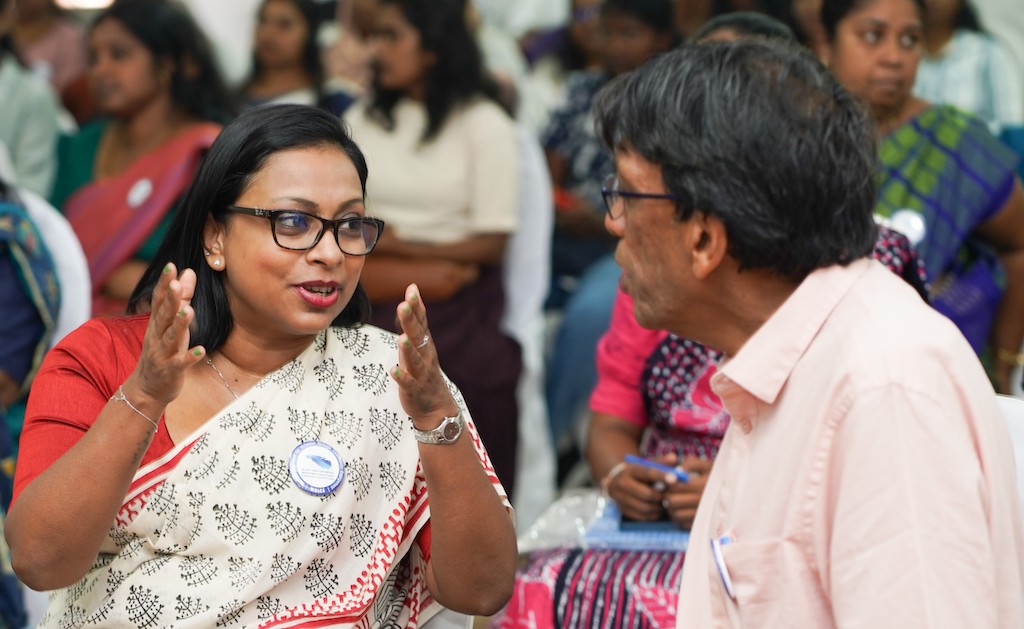
The Women Organized for Inclusion through Community Engagement (WOICE) National Symposium was held in Colombo, bringing together women leaders from Badulla, Kandy, Kegalle, Nuwara Eliya, Matara, Monaragala and Polonnaruwa, where the project was implemented in its second phase.
The project focuses on strengthening both emerging and experienced women leaders to become effective voices for marginalised communities while fostering unity across communities.
Dr. Kaushalya Ariyarathne, Deputy Minister of Mass Media, was the chief guest. NPC Executive Director Dr. Jehan Perera and Sumadhu Weerawarne Perera Programme Adviser also addressed the meeting. A panel discussion with seven panelists representing each district was held and moderated by Ms. Perera.
Dr. Ariyarathne explained the important role of civil society and emphasised that civil society organizations should not rely solely on funding since funds would not last long. Effective and meaningful work would ensure their long term sustainability. She added that civil society must play an active role in influencing governments to bring about positive social change.
She spoke about the burden of care work, government policy initiatives and their impact on women’s leadership and mentioned that the government was increasing the number of safe houses for women and children. Participants suggested that at least one safe house should be established in each district because victims of domestic violence were often forced to return to the same place where the abuse had taken place.
Dr. Ariyarathne said that there were many vacancies for police officers, particularly for Tamil-speaking and female officers, and encouraged participants to inform youth in their districts about these opportunities and to apply so that the institutions could provide more effective and people-friendly services.
Each district depicted its experiences and achievements through creative presentations such as drama, discussions and songs, showcasing the strength and diversity of projects for the empowerment of women and the role that the community could play in improving relationships and fostering support for women in the community.
The presentation from Kandy focused on improving health and community resources. The group identified two problems, one with sanitation and the other with trash and dirt in the canals. It was found that solving the problems collectively created a benefit for the community so they formed a youth and super group to clean toilets and canal infrastructure. The group shared the success of the activity through a song.
The Monaragala group highlighted the issue of access to electricity. It collaborated with a rural village lacking electricity to include it in the power grid. To make this happen, the group involved state and local officials to implement an electricity pilot project that brought electricity to the village and strengthened municipal and state collaboration for shared goals.
The presentation from Nuwara Eliya tackled the issue of domestic violence, identifying an increase in cases and a lack of public education to reduce it. A coalition for women and children engaged schools and state institutions to lead an education initiative about what the term domestic violence means, why it is harmful and ways for community members to reduce it. The coalition advised specific families, particularly men who had engaged in domestic violence, on how to change their behaviour.
The Matara group focused on inclusion of Muslim women in politics, identifying a candidate without a political family background or connections and facing opposition from both the majority party and family members. Outside of traditional support mechanisms, the candidate engaged in direct grassroots advocacy, speaking to constituents about what mattered to them, which allowed her to run a successful campaign.
In Polonnaruwa, the group used innovative agriculture solutions to tackle the problem of elephants moving through at night, making it unsafe for people to walk outside. Knowing that elephants were averse to citrus, the group led an initiative to plant lime trees so that the elephants would move away peacefully.
The Badulla group led a project to empower women to serve as leaders in the society in formal and informal capacities, conducting small panel discussions, and focused on the need for information and education. It determined that there needed to be greater education for women about the laws and political situations on issues like domestic violence so that they could advocate for themselves and others.
The team from Kegalle addressed the issue of caste divisions with a collective of pot makers who had experienced discrimination as a result of their caste. They presented a drama showing the distinction between occupation and identity, emphasising that a job should not determine a person’s worth or the level of respect they were afforded in community.
The seven regional presentations showcased the rich diversity of community initiatives that supported women and how projects led by women could have wide reaching positive impacts on the community. The projects cultivated female leaders and role models and provided a model of the kind of progress that could be made through mutual support and collaboration.
Participants expressed concerns about the misuse of freedom of expression and media freedom, particularly in the harassment of women through traditional and social media. It was noted that harassment also occurred within Parliament, targetting women political representatives. Participants urged the minister to take action to ensure a safer environment in the future.
Issues faced by youth in the Malaiyaha community were also discussed. It was highlighted that students in the community had limited access to quality education due to language and transportation barriers as well as financial difficulties.