

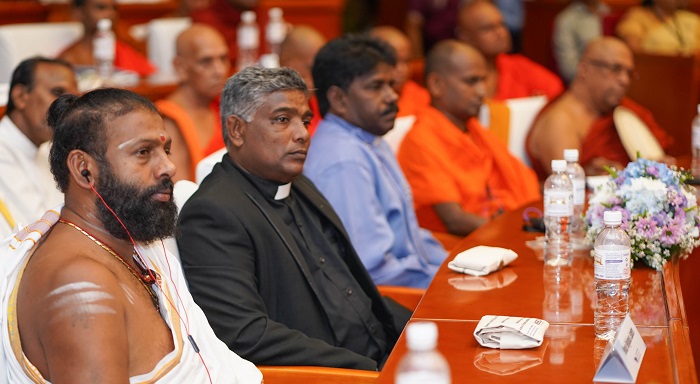
NPC brought together over 300 religious leaders, government officials, women and youth representatives, civil society actors and community members from 16 districts for the Religions to Reconcile: Advancing Ethical and Inclusive Reconciliation National Symposium, which served as the closing ceremony of the Plural Action for Inclusion, Reconciliation, and Social Justice (PAIRS) project implemented across the country from July 2024 to June 2026 with the support from Misereor/KZE and CAFOD.
Religious leaders, university students, female leaders and national and local government public representatives involved in operational projects in 16 districts initiating inter religious reconciliation and social justice attended the seminar, which began with the lighting of the oil lamp followed by a welcome address from NPC’s Assistant Manager Ayesha Jayawardana, who set the tone for a day of reflection, celebration and forward looking dialogue.
PAIRS Project Manager Nirosha Anthony provided a comprehensive project overview, explaining how the project had networked inter religious groups, capacitated state officers in pluralistic administration and empowered multi-sectoral groups including women, youth, and civil society organizations to advocate for marginalised communities such as plantation workers, indigenous Vedda communities, persons with disabilities and LGBTIQ+ individuals across the 16 districts.
A documentary screening brought the project's impact to life, showcasing the transformation of District Inter Religious Committees (DIRCs) from informal dialogue platforms into robust advocacy networks capable of mediating tensions, influencing policy and promoting social justice at the grassroots level.
Minister of Transport, Highways and Urban Development, Bimal Rathnayake, who delivered the keynote speech said the government’s priority since 2024 had been stabilisation after the economic and political crisis, with reconciliation linked to a future stage of transformation.
Mr. Rathnayake declared that Sri Lanka now had a government that does not show racism and does not use racism for elections. "There is a South that accepts the North and a North that accepts the South… Some people have invested in racism throughout history," he said.
In his address, MP Sivagnanam Sritharan acknowledged the critical role of civil society in bridging communities divided by decades of conflict, while emphasising the need for transitional justice and memorialisation. He raised concerns over unresolved land disputes, alleged encroachments and the continuing military presence in the north and east.
Former minister Mano Ganesan highlighted the longstanding housing and land problems faced by the Malaiyaha Tamil community and the impact of the Ditwah cyclone on estate areas.
Opposition Leader Sajith Premadasa stressed the need for equality, justice and inclusive governance to achieve lasting reconciliation. He acknowledged the importance of civil society led reconciliation efforts in complementing state initiatives and calling for continued cross party consensus on peacebuilding and pluralism. He said that reconciliation could not be achieved by government alone and that the kind of grassroots engagement demonstrated by the PAIRS project was essential for building lasting social cohesion.
NPC Chairman Dr Joe William said the work of NPC and its DIRCs belonged to the people of Sri Lanka. “It is rooted in our soil, driven by our communities and sustained by the dedication of ordinary men and women who believe that coexistence is not a luxury but a necessity.”
NPC Executive Director Dr. Jehan Perera said the country had a unique opportunity to move beyond divisive politics and build a more united and pluralistic society, adding that transformation should begin immediately and not in the indefinite future.
Chairperson of the Office for Missing Persons (OMP) Mahesh Katulanda addressed the complex theme of transitional justice, pointing out that truth seeking and accountability mechanisms must go hand in hand with reconciliation efforts if lasting peace is to be achieved.
The segment of the symposium, Showcase of Impact: The DIRC Success Journey, celebrated the achievements and positive impact of DIRCs through creative presentations. Colombo DIRC showcased urban pluralism and policy engagement, demonstrating how inter religious advocacy could influence decision makers at the highest levels of government.
Nuwara Eliya DIRC opened with a documentary highlighting its work with Malaiyaha Tamil plantation communities, addressing generational marginalisation and demonstrating how inter religious dialogue helped bridge ethnic and linguistic divides in the estate sector.
Anuradhapura DIRC followed with a documentary on the experiences and challenges of the Telugu community. It underscored the need for a plural and inclusive society driven by the active engagement of religious leaders, government officers, women, youth and CSO representatives to foster mutual understanding, peaceful coexistence and reconciliation.
Kandy DIRC presented a documentary on minority rights while Badulla DIRC focused on social cohesion in the Uva Province, highlighting successful mediation of land disputes between ethnic communities and advocacy for equitable resource allocation.
Kegalle DIRC challenged longstanding discriminatory practices through a documentary on caste and social inclusion, advocating for the rights of marginalised occupational groups while Monaragala DIRC presented a short drama on marginalised community voices, bringing attention to the challenges faced by remote rural populations often excluded from national discourse.
Ratnapura presented documentaries addressing marginalised groups such as the differently abled and estate communities, and language rights for mediation. Matara DIRC had a documentary on coastal community inclusion and the unique challenges faced by fishing communities affected by economic and environmental pressures.
Vavuniya DIRC captivated the audience with a short drama portraying the emotional journey of families separated by conflict and the role of DIRCs in facilitating cross-community dialogue and trust building while Batticaloa DIRC presented a drama depicting the experiences of Muslim and Tamil communities in the Eastern Province, illustrating how religious leaders had come together to condemn violence and promote collective action for peace.
Puttalam DIRC shared its success in engaging civil society organizations and identifying donors to address infrastructure needs of underserved and excluded communities while also creating market opportunities for people with disabilities and Polonnaruwa DIRC brought traditional Virindu folk poetry to the stage, using art and culture to convey messages of harmony and coexistence in a manner that resonated with the audience.
Jaffna DIRC staged a modern drama that depicted the troubling sword culture prevalent in Jaffna while Galle DIRC's documentary offered Southern perspectives on reconciliation, highlighting how communities in the South had engaged with the project's objectives and adapted them to local contexts. Kurunegala DIRC's documentary focused on rural interfaith cooperation, showcasing how small town religious leaders had built trust across denominational lines.
Throughout these presentations what emerged was a powerful narrative of transformation: DIRCs that had begun as experimental dialogue platforms had evolved into sustainable, community-owned mechanisms for conflict prevention, advocacy and social justice with religious leaders from Buddhist, Hindu, Muslim, Catholic and evangelical traditions working side by side with women leaders, youth networks and civil society organizations to address everything from domestic violence and access to education to land rights and political representation.
As the participants departed to their home districts, they carried with them not only the memories of a day of celebration but also the practical tools, networks and commitments needed to sustain inter religious dialogue, inclusive governance and social justice in the challenging but hopeful years ahead.
What Minister Rathnayake had declared that there is a South that accepts the North and a North that accepts the South was not merely a political statement but a reality demonstrated by the 300 religious leaders and community representatives who had gathered from every corner of the island, proving that pluralistic inclusion was not just a project objective but an achievable and achieved outcome of the PAIRS initiative.