

Some opposition political parties have strived hard to turn the disaster of Cyclone Ditwah to their advantage. A calamity of such unanticipated proportions ought to have enabled all political parties to come together to deal with this tragedy. Failure to do so would indicate both political and moral bankruptcy. The main issue they have forcefully brought up is the government’s failure to take early action on the meteorological department’s warnings. The opposition even convened a meeting of their own with former president Ranil Wickremesinghe and other senior politicians who shared their experience of dealing with natural and man-made disasters of the past, and the present government’s failures to match them.
The difficulty to anticipate the havoc caused by the cyclone was compounded by the neglect of the disaster management system, which includes previous governments that failed to utilise the allocated funds in an open, transparent and corruption free manner. Land designated as “Red Zones” by the National Building Research Organisation (NBRO), a government research and development institute , were built upon by people and ignored by successive governments, civil society and the media alike. NBRO was established in 1984. According to NBRO records, the decision to launch a formal “Landslide Hazard Zonation Mapping Project (LHMP)” dates from 1986. The institutional process of identifying landslide-prone slopes, classifying zones (including what we today call “Red zones”), and producing hazard maps started roughly 35 to 40 years ago.
Indonesia, Thailand and the Philippines which were lashed by cyclones at around the same time as Sri Lanka experienced Cyclone Ditwah were also unprepared and also suffered enormously. The devastation caused by cyclones in the larger southeast Asian region is due to global climate change. During Cyclone Ditwah some parts of the central highlands received more than 500 mm of rainfall. Official climatological data cite the average annual rainfall for Sri Lanka as roughly 1850 mm though this varies widely by region: from around 900 mm in the dry zones up to 5,000 mm in wet zones. The torrential rains triggered by Ditwah were so heavy that for some communities they represented a rainfall surge comparable to a major part of their typical annual rainfall.
Inclusive Approach
Climate change now joins the pantheon of Sri Lanka’s challenges that are beyond the ability of a single political party or government to resolve. It is like the economic bankruptcy, ethnic conflict and corruption in governance that requires an inclusive approach in which the opposition, civil society, religious society and the business community need to join rather than merely criticize the government. It will be in their self-interest to do so. A younger generation (Gen Z) with more energy and familiarity with digital technologies filled the gaps that the government was unable to fill and, in a sense, made both the opposition and traditional civil society redundant.
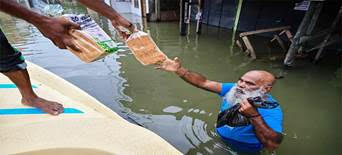
Within hours of news coming in that floods and landslides were causing havoc to hundreds of thousands of people, a people’s movement for relief measures was underway. There was no one organiser or leader. There were hundreds who catalysed volunteers to mobilise to collect resources and to cook meals for the victims in community kitchens they set up. These community kitchens sprang up in schools, temples, mosques, garages and even roadside stalls. Volunteers used social media to crowdsource supplies, match donors with delivery vehicles, and coordinate routes that had become impassable due to fallen trees or mudslides. It was a level of commitment and coordination rarely achieved by formal institutions.
The spontaneous outpouring of support was not only a youth phenomenon. The larger population too contributed to the relief effort. The Galle district secretariat sent 23 tons of rice to the cyclone affected areas from donations brought by the people. The Matara district secretariat made arrangements to send teams of volunteers to the worst affected areas. Just as in the Aragalaya protest movement of 2022, those who joined the relief effort were from all ethnic and religious communities. They gave their assistance to anyone in need regardless of community. This showed that in times of crisis, Sri Lankans treat others without discrimination as human beings, not as members of specific communities.
Turning Point
The challenge to the government will be to ensure that the unity among the people that the cyclone disaster has brought will outlive the immediate relief phase and continue into the longer term task of national reconstruction. There will be a need to rethink the course of economic development to ensure human security. President Anura Kumara Dissanayake has spoken about the need to resettle all people who live above 5000 feet and to reforest those areas. This will require finding land for resettlement elsewhere. The resettlement of people in the hill country will require that the government address the issue of land rights for the Malaiyaha Tamils.
Since independence the Malaiyaha Tamils have been collectively denied ownership to land due first to citizenship issues and now due to poverty and unwillingness of plantation managements to deal with these issues in a just and humanitarian manner beneficial to the workers. Their resettlement raises complex social, economic and political questions. It demands careful planning to avoid repeating past mistakes where displaced communities were moved to areas lacking water, infrastructure or livelihoods. It also requires political consensus, as land is one of the most contentious issues in Sri Lanka, tied closely to identity, ethnicity and historical grievances. Any sustainable solution must go beyond temporary relocation and confront the historical exclusion of the Malaiyaha Tamil community, whose labour sustains the plantation economy but who remain among the poorest groups in the country.
Cyclone Ditwah has thus become a turning point. It has highlighted the need to strengthen governance and disaster preparedness, but it has also revealed a different possibility for Sri Lanka, one in which the people lead with humanity and aspire for the wellbeing of all, and the political leadership emulates their example. The people have shown through their collective response to Cyclone Ditwah that unity and compassion remain strong, which a sincere, moral and hardworking government can tap into. The challenge to the government and opposition will be to ensure that the unity among the people that the cyclone disaster has brought will outlive the immediate relief phase and continue into the longer term task of national reconstruction with political reconciliation.