

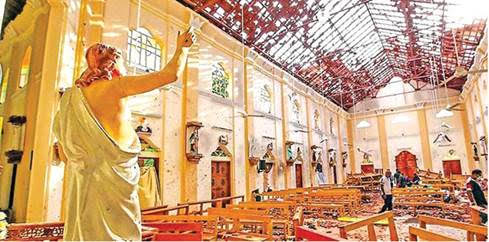
The present government was elected on a commitment to prioritise truth, justice, and accountability to which it is being held by the Catholic Church in particular. This may account for the renewed momentum in investigations into the 2019 Easter Sunday bombings which was one of the gravest acts of violence in Sri Lanka’s recent history. A story on the recent developments in the Easter Sunday bombing investigation refers to a father whose six year old daughter died in the explosions that killed 279 people. The news report quotes him saying, “If she were alive today, she would be 13. You cannot suppress the truth for long. Now it’s starting to come out. We want the full truth and justice. Our children did not die in vain.” https://www.ucanews.com/news/sri-lanka-arrests-ex-intelligence-chief-over-2019-easter-bombings/112031 His words capture the ache of continuing grief and the refusal to let memory fade into oblivion.
The desire for justice, especially for loved ones killed by the actions or omissions of others, is universal. It is seen in the mothers of the North, in Jaffna and other towns, who have sat by the roadside year after year asking what happened to their children who disappeared in 2009 when the war ended or even earlier as when 158 people were taken from the temporary refugee camp in Eastern University in Vantharumoolai, Batticaloa, on September 5, 1990 never to be seen again. The reality, however, is that the suffering of individuals is easily submerged in the larger schemes of power. Governments are concerned about retaining political power, security forces close ranks, and societies are encouraged to forget in the name of stability, economic recovery, or national pride.
In Sri Lanka that forgetting has not taken place. Due to the sustained efforts of the Catholic Church and the families of the victims, the demand for truth and justice regarding the Easter Sunday attacks has not gone away. It has persisted through indifference, hostility, and at times intimidation. It is perhaps this persistence that has made the arrest of retired Major General Suresh Sallay a significant moment for those who have not forgotten. The arrest of General Sallay, who once headed military intelligence and later the State Intelligence Service, has been controversial. He is widely credited with playing a significant role in dismantling the LTTE’s networks and is regarded by some as one of the country’s most capable intelligence officers.
Persisting Doubts
From the very day of the Easter bombings in April 2019, there has been a doubt that the attacks were too meticulously planned to have been carried out solely by a ragtag group of youth or radicalised men acting on their own. The suspicion of a “grand conspiracy” has existed from the beginning and was voiced even by senior legal officials involved in the investigations. The attacks were claimed to be staged by ISIS, whose leader issued a statement claiming credit for them as part of a global ideological struggle. But this did not answer the central question about why known Muslim extremists were not apprehended when the war with the LTTE had ended many years before and they were no longer needed as a counterforce and why repeated intelligence warnings from India were ignored.
For seven years successive governments failed to move beyond the finding of negligence on the part of those who were in charge of national security. Investigations stalled and key questions remained unanswered. A parliamentary committee questioned whether sections within the intelligence community, supported by some politicians, sought to undermine investigations.
The Supreme Court held several government leaders and senior officials guilty of negligence and dereliction of duty, imposing heavy fines. That judgment established that the state failed its citizens. But negligence is one thing. Deliberate connivance is another. The present government was elected in 2024 on a promise that the truth behind the Easter attacks would be uncovered. President Anura Kumara Dissanayake committed himself publicly to accountability.
As several foreigners including US and UK citizens also lost their lives in the bombings, foreign intelligence agencies from the United States, the United Kingdom and other countries came to Sri Lanka soon after the attacks to conduct their own inquiries. The US has filed charges against three Sri Lankans. So far, international findings have not identified an external mastermind directing the plot from abroad. The focus remains on possible failures or complicity within.
Indeed, by arresting a former intelligence head who was widely credited with playing a significant role in dismantling the LTTE, the government has taken a considerable political risk. Opposition politicians and nationalist voices have framed the arrest as a betrayal of the security forces and an attempt to appease external actors. Others have suggested that it is a diversion from present economic or political challenges.
Beyond Easter
The Catholic Church, which most directly represents the victims of the Easter attacks, has expressed support for the renewed investigations. The involvement of the Church has helped to take the issue beyond the realm of partisan party politics and to one of the search for truth and justice. But this search for the truth cannot be limited to the Easter bombings. It needs to extend beyond this particular bombing, heinous though it was. A state that investigates only one atrocity while ignoring others signals that some lives matter more than others. That is a dangerous message in a country that has been divided along ethnic and religious lines. Truth seeking is not a betrayal of those who fought in difficult circumstances. It is an affirmation that the rule of law applies to all. It strengthens institutions by cleansing them of suspicion. It restores trust between citizens and the state.
Sri Lanka’s modern history is marked by many unresolved crimes. Large scale killings, enforced disappearances, and extrajudicial actions during the period of the ethnic war remain unaccounted for. There were churches and orphanages bombed during the war. There were hundreds taken from camps or who surrendered only to disappear forever. Thousands of families continue to live without answers. The mothers of the disappeared have not gone away.
They sit in the heat and rain because they cannot forget their children and want to know what happened to them. Their persistence mirrors that of the Easter victims’ families. Both ask the same question. Who was responsible and why. For too long Sri Lanka has avoided these questions, arguing that reopening the past would endanger stability and that the path to success is to focus on the future.
But memory and the desire for truth and justice does not die. By prioritising truth and justice as governing principles, the government can begin to restore faith in public institutions. This requires investigating what happened and why accountability was denied. Healing the wounds for Sri Lanka does not lie in forgetting the dead. Justice is not only punitive. It is also restorative. It allows societies to move forward without carrying unspoken burdens.
The Easter Sunday victims, the disappeared of the war years, and all those lost to political violence belong to the same community of Sri Lankan citizens that the government has pledged to treat equally. This calls for a consistent standard of truth. By pursuing the Easter investigation wherever it leads and by reopening and resolving the unresolved crimes of the war years, the government can set the country on a path of redemption.